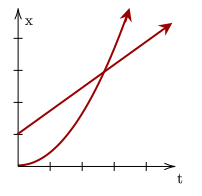
So far, we have been dealing with the motion of one object only. To conclude our exploration of one-dimensional kinematics, we analyze the motion of multiple objects.
While daunting, it is as simple as setting up multiple equations for each object, and seeing how they relate to each other. One must be wary of various factors, such as the signs of values, and any implied values.
One common type of problem which involves multiple objects are pursuit problems, where one object catches up to another.
The speeding car can be modelled by a particle undergoing constant velocity, while the police car has constant acceleration. With this, we can model the two with the following equations.
The police car will catch up to the speeding car when their positions are equal, so we equate them, then solve for .
Discarding the solution, we have the other solution at .
It sort of feels like we don't have enough information, however we must analyze the problem carefully.
With the same speed and acceleration, it means that they will hit at the 500-m mark, the exact middle of the 1000m. Further, since they are breaking, they have to come to rest at 500-m exactly. This gives us the final, initial, and displacement, which is enough for the fourth equation to work out.
This gives us that the deceleration has to be −0.9m/s² to avoid collision.
The rest of the problems below are varied in how they can be solved, and they are arranged in (supposedly) increasing difficulty.
The speed of the second-placer is given by .
Since 11.2s is the fastest time, the distance the second-placer run can be computed.
Which means that she was 3.45m behind the first-place winner.
The next problem is a variation of the previous problem.
For the sake of simplicity, let's say that Bob runs the 100-m dash in 10s. This means his speed is . Further, Judy should be able to run 90m in 10s, given that she was 10m away from him when he won, so her speed is .
Having Bob start 10m before the starting line means he has to run 110m in total. With his speed of 10m/s, he will take .
In those 11s, Judy should be able to run . However, that means that Judy still doesn't pass the 100m mark, meaning Bob will still win.
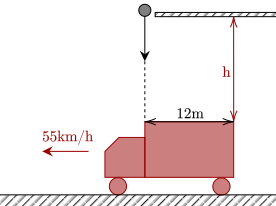
The first thing we need to find out is how long it takes for the truck to go 12m, or its entire length. Since it isn't accelerating, we can find it quite easily. We just need to convert 55km/h to m/s first.
Now we set up the equation.
This gives us . Now, we know the final height to be at the top of the truck, so let's set that as zero. It is also implied that it started at rest, so our initial velocity is 0m/s. We have enough information then to use our third equation.
We get that the railing must be 3.06m from the top of the truck.
This question may seem familiar, however it is more complicated than Exercise 2. One technique you can employ is to try to digest the problem first; what things could be useful?
We first need to get a footing with the problem. One way is to find out how long it takes for them to crash. Since both trains have constant velocity, they can be modelled by the following two equations, with the second train having an initial position of 102km.
Equate the two equations:
This gives us that the time before the trains collide is . What now?
Now, note that this is the amount of time the bird is flying between the two planes. Since it is implied that the bird doesn't stop, it must mean it must've been flying for the whole 1.5h at a speed of 58km/h. Thus, we can easily get the distance it travelled.
As we conclude one-dimensional kinematics and step into the second dimension, most of the lessons we learned here will still hold true in the second dimension.