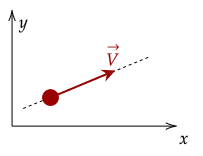
Now that we are moving in two-dimensions, we need to deal with how we treat direction. We know that most quantities need direction, like velocity and acceleration.
For this one-dimensional case, a simple flip of the signs works. For free falling objects, we almost always set "going up" as positive velocity and "going down" as negative velocity.
These quantities that need direction are called
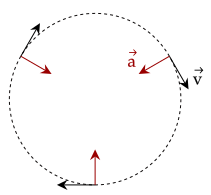
The figure above shows a person running around in a circle. We can see that their velocity is changing direction, and thus changes. However, the
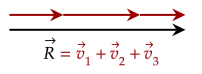
In two dimensions, we can't rely on changing signs. For example, in one-dimension, we can add vectors by just adding their magnitudes up. The vector we get from adding these up is called the
To add two-dimensional vectors however, we have to do a different way. Visually, we just add them up tip-to-tail.
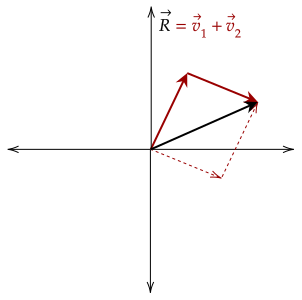
To add them numerically, we first need to break down the vectors. A vector can be broken down into its
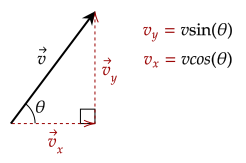
One must recall their trigonometry to deal with this; especially the
We can also use these components to get the magnitude and the angle of the vector via the pythagorean theorem and using the
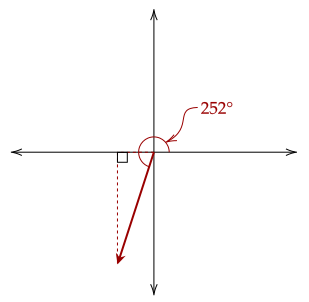
The reference angle of 252° is 72°, we take the sine and cosine of that angle to get the magnitudes of the two components.
This gives us the two component vectors.
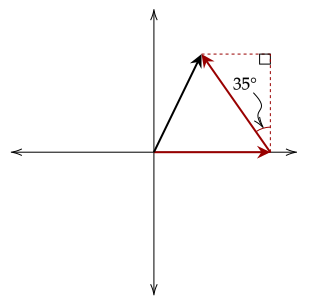
We take the sine and cosine of the angle to get the two components of the angled vector.
To get the magnitude, we use the pythagorean theorem.
For the angle measure, we use the arctan() function.
Thus, we get that is a vector with magnitude 4.45 units and direction 52.20° counterclockwise from the +x axis.
One way to represent a vector is by using
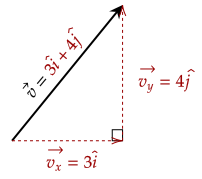
We first parse what the two vectors mean. The first vector has a length of 2 going to the right and a height of 3 going up, while the other vector
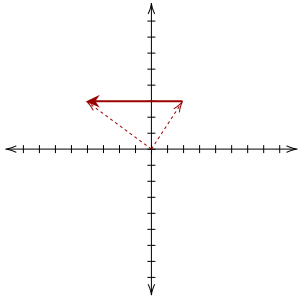
We got these values by looking at the unit vectors they are composed out of.
To do this formally, we use the distance formula, which is powered by the pythagorean theorem.
One may notice that this shows that the x-component and y-component of a vector is separate; and thus we can separate motion in two dimensions to two cases of one-dimensional motion, which we've studied.
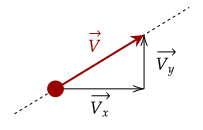
We can now deal with some problems about motion in two dimensions, where we just have to break down the vectors into its components and work at it from there.
Be warned; this may seem like a large jump in complexity as there looks to be a lot of information, however just remember one thing: two-dimensional motion is two cases of one-dimensional motion.
The acceleration appears to only move in the x-axis, so the velocity's y-component will not be affected. We can calculate the velocity by just using our kinematic equations. To make it less confusing, let's add a subscript of and to determine what dimension we are using.
This gives us that the velocity at 10s is m/s. For position, we have to separate it first into the x-component and y-component. For the x-component, we have an initial velocity, acceleration, and time, so we use our third equation.
The y-component is much easier, as there is no acceleration to worry about. We use the first equation instead, as the velocity is constant.
This gives us that the position at 10s is at m.
The x-component of velocity has gone from 10m/s to 0m/s in four seconds. We can plug this into our second kinematic equation.
Similarly, the y-component of velocity has gone from 20m/s to 10m/s in four seconds. Plugging this in gives us the y-component of the acceleration.
We thus get that the acceleration vector is given by m/s².
We must use calculus to get the velocity and position functions. Since the initial velocity and position is zero, we may drop the arbitrary constant.
Starting with the x-component, we first get the velocity then position function.
We follow a similar way for the vertical component.
This gives us the velocity function is m/s, while the position function is m/s.