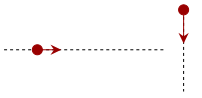
To tackle more difficult applications of kinematics, we first deal with motion in one-dimension; in other words, we limit particles to move in a line, as shown below.
With calculus, we have found ways to relate the time to the position, velocity, and acceleration. Now, we show how to derive these same equations using algebra, along with sample problems. To begin, we have to do some simplifications.
So far, we've been using for our calculations. However, we can simplify that to be a single variable if we use the assumption that we set the initial time to be at zero.
Another thing this does is we can drop the subscript for both the change in velocity and change in position equations.
One other assumption (that is very important!) is that we set the acceleration to be constant. This assumption greatly simplifies our equations, and overall will make our life a lot easier. This type of motion (where acceleration is constant) is called uniformly accelerated motion.
Is this a big deal? Not really. Most objects can be modelled well (and with enough accuracy) with a particle under constant acceleration.
With constant acceleration, that means that the average velocity is then just the average of the final and initial velocities. We know how constant acceleration looks
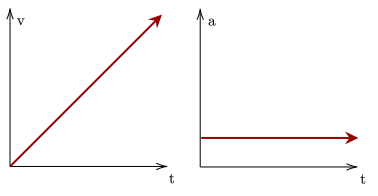
To get our first equation, we manipulate our original equation for average velocity, .
This equation relates displacement, velocity, and time. We can use this equation to get the displacement of a particle given its initial and final velocities, or, if given the velocity is constant.
Since the velocity is constant, the average velocity must just be . The time starts at 0s and ends at 5s, which gives us . We can assume for that the initial position of the object is at 0m, given that it wasn't stated. With this, we can get the position of the object.
We can also use our definition of average acceleration (being ) to get another equation. We can drop the average acceleration as we assumed it to be constant.
This equation seems similar to the one we collected before, however it relates velocity, acceleration, and time. Further, it aligns with what we got from integrating a constant acceleration.
It appears that we don't have enough information; we know and , however it seems we don't know the final velocity.
However, reading carefully, it is stated that he was "brought to a stop", which means that the final velocity is at rest, or . We can now solve for :
Setting "going left to right" as positive, we get the initial velocity at 5m/s and final velocity at −8m/s. The time elapsed is also given, at 10s. This is enough to find the acceleration.
This gives our constant acceleration at . We then use this to find the initial velocity. We use the first value of velocity (5m/s at t = 10s), however the other value should work fine as well.
We can then use this to get the instant the velocity is zero.
Which gives us that the velocity is zero at approximately .
While it is useful to have these two equations, we still don't have any way to relate acceleration and displacement. We first try to replace the in the first equation.
We manipulate our second equation to find . To do this, we add to both sides and divide both sides by two:
Substituting our new value gives us our third equation.
One thing to note that this equation is quadratic, which aligns with the
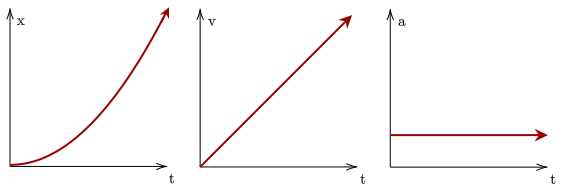
Further, this equation aligns with what we collected from integrating from constant acceleration twice; we have successfully derived it from algebraic principles.
We have enough information to use our third equation; the displacement 50m, the time 2s, and the initial velocity 72km/h. We first convert 72km/h to m/s:
We can now use the third equation by plugging the values in. We note that the initial position can just be set to zero.
Which gives the value of .
We are given three values, the acceleration at 6.0m/s², the initial velocity at 2.0m/s, and the displacement at 5.0m. This is enough to use our third equation to get the time:
While all three equations are good, we can extract one more. We don't have any equation which doesn't use time. To fix that, we can manipulate the same equation we manipulated last time again to find another value for time.
We then substitute that value to our third equation to get an equation without . To remove , we can just subtitute .
Recall that , so we can simplify the left side. The right side is a
This equation is now time-independent. It can be used when we don't know how long something took to happen.
We aren't given the time, so we should use the time-independent equation. We have a initial velocity of 7.50m/s, final velocity at rest, and a displacement of −0.350m (negative as it "compresses" the padding, so it moves back into the person).
This gives us enough information to get the acceleration.
With the four kinematic equations, we can now solve problems numerically. However, one thing to note is that somethings in physics may not be said outright; "rest" meaning velocity is zero was an example in an exercise. Read the question carefully to glean all the information within it!
We need three variables of the five (displacement, initial and final velocity, time, and acceleration) to solve the other two.
Here is a fun fact: the velocities and accelerations used in the kinematic equations are instantaneous, as they are the velocities and accelerations at a given instance of time.