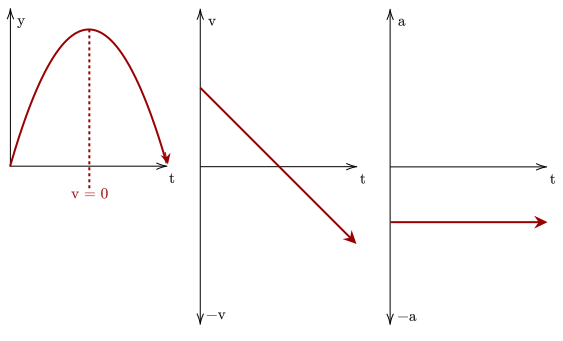
Most objects on Earth fall down. This "falling down" is an example of uniformly accelerated motion. Objects which are affected solely by this acceleration are said to be in free fall.
You may notice that this term isn't called "gravity".
This is because there is a distinction between
The main thing to get out from that is that this gravitational acceleration is basically constant.
We should first accustom ourselves to this gravitational acceleration. It can be seen in the motion-graphs (with "going up" as positive) that the position of a particle under gravity goes up, peaks, and then goes down.
It should be noted that while the velocity is changing, the acceleration isn't.
The object's velocity becomes zero when the object reaches its peak; this is because if it weren't zero, it would go either higher or lower.
Its velocity also changes direction; from the figure above, it starts out positive, going up, then becomes negative as it goes down.
The gravitational acceleration of a particle is constant, so it doesn't change sign.
It doesn't matter what the projectile's initial acceleration is; after it is released, it is solely under gravity, thus its acceleration is just the gravitational acceleration.
We now tweak our kinematic equations to be fit for free fall. Since we are going up and down, we should use the symbol instead of .
Finally, we need to set our coordinate system; in other words, if an object goes up, should its position become more positive or more negative?
To make it simple, we set "going up" as positive and "going down" as negative. Since acceleration due to gravity pulls things down, it is right to set that as negative as well. Thus, we set .
Note that some problems benefit with "going down" as positive, which in that case .
We have the initial position at 105.0m, and we know how much time elapsed, being 1.50s. We may not have the average velocity, but we have the initial velocity at rest.
This points us towards our third equation. We set "going up" as positive.
To find the time, we note that it hits the man when the position is at . We can use our third equation again, and this time solve for time.
Using the quadratic equation, we get that . There is a negative solution, but we discard that. Given 1.50s has passed, the amount of time left for the man to react is 3.13s.
Since we threw it from the ground, the initial position is at 0m. Looking at the problem, we have the position and initial velocity as well. This points us towards our third equation, where we solve for time.
We get that and . Their difference is then 1.91s.
When does a particle reach it's max height? Well, it should be at the point just before it goes down, or when the velocity is just about to go negative. When is that? It's when the velocity is zero.
Since the velocity at the peak is 0m/s, we have a final velocity. We also have the maximum height. With this, we choose to use equation four, as it is time-independent.
We get that .
Once again, we have both a time (2.25s), an initial position (0m), and final position (36.8m). We choose to use the third equation to answer the first question.
We get that . With the initial velocity, we can use the second equation to get the velocity at that given time.
We get that the current velocity is . Finally, we get the peak height by using the fourth equation and setting the velocity to zero.
Which gives us the maximum height of 38.3m. Given its already gone up 36.8m, it has 1.50m left to go.
This problem is a lot harder than the other problems as it feels that we have too little information; we don't know how fast the object was going at impact, and how long it took to fall; we only thing we can glean is that started from rest.
Let's just make up some values and see where that gets us. We know that the object hits the ground at some time we don't know, so let's let that time be . It starts from max height, and ends at the ground. We drop the velocity term as it is zero (from rest).
We also know that it descended the last third of the building in one second, so in the remaining s it descended two thirds of the building. This gives us this equation.
Now we are getting somewhere. We have two values for height, so we substitute the first value of height into the second equation.
Using the quadratic equation, we get that t = 5.45s and t = 0.55s. We discard the time value less than one second since that violates the rules of the problem. Thus, we substitute t = 5.45s to our equation.
Which gives us the height of the building is 145.5m.
To end this tutorial on free fall, we show how we can get these equations via integrating with respect to the constant gravitational acceleration. Given that we set positive as "going up", the gravitational acceleration is thus .
Integrating this again gives us the position function.